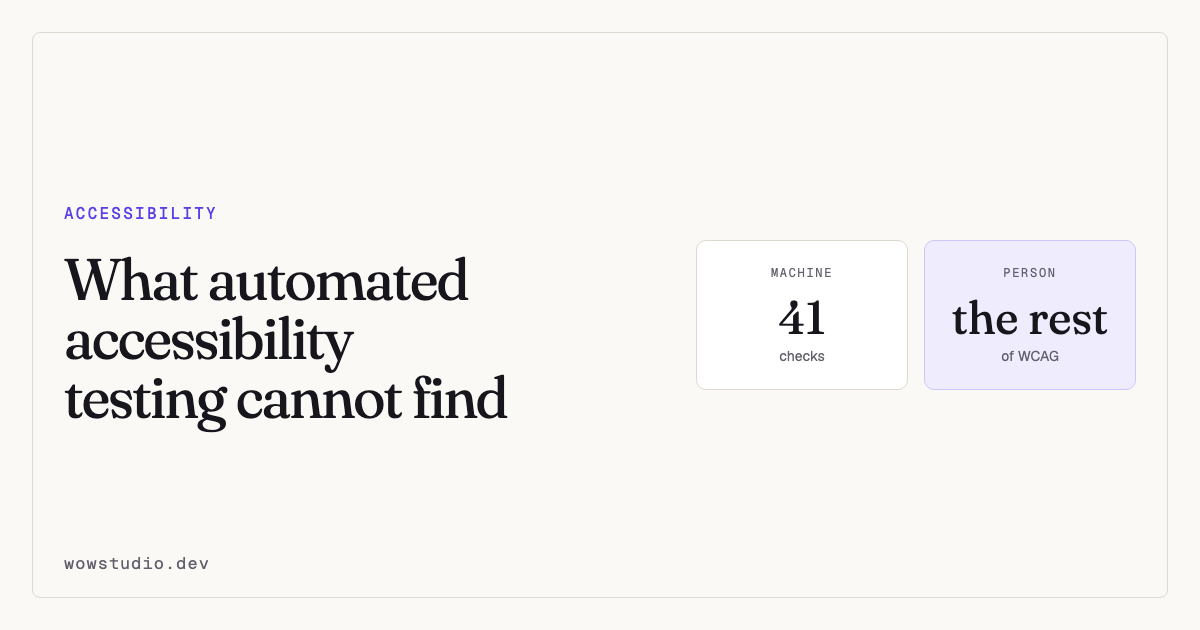
A clean automated report means the checks that ran found nothing. It does not mean your site is accessible. Every honest tool says this. Most people read past it, because a green number is more comforting than a caveat.
The useful question is not “is automation enough” — it plainly is not — but exactly where the line falls, so you know what you still owe.
What automation does well
Machines are excellent at things with a definite answer in the markup or the rendered page:
- An image with no
altattribute - A button or link with no accessible name
- A skipped heading level, a duplicate
id, a broken ARIA reference - A missing page title or
langattribute - A table with no header cells
- Contrast ratios, where the background can be determined
- Targets below 24 by 24 pixels
- A positive
tabindex - An element hidden from screen readers but still focusable
That is real work, it is genuinely tedious by hand, and it is where a tool earns its place. On a site nobody has checked, this will be most of your finding count.
What automation cannot judge
Whether your alt text is right
A check can see that alt text exists, is not the filename, is not absurdly
long. It cannot see the image. alt="team photo" on a product shot passes
every automated check and tells the listener something false.
Whether a heading describes its section
Structure is checkable. Meaning is not. A perfectly nested outline of meaningless headings passes.
Whether focus order makes sense
A tool can find a positive tabindex. It cannot tell you that tabbing through
your checkout jumps from the postcode field to the footer and back.
Whether link text works in context
Known vague phrases are catchable. A link reading “the 2024 report” in a paragraph discussing three reports is not.
Whether an error message helps
That it exists is checkable. That it tells somebody how to fix their mistake is a judgement.
Whether your content is understandable
Reading level is a syllable count. A page of short sentences made entirely of jargon scores beautifully and is impenetrable.
Whether a task can be completed
The big one. No automated check can tell you whether somebody can actually buy the thing.
Why the honest tools report two numbers
Some checks can spot a situation without being able to settle it. An audio element probably needs a transcript — but it may have one on the page already. Bold text may be standing in for a heading, or may be emphasis.
Reporting those as barriers inflates the count and trains you to ignore the list. Hiding them loses real information.
So Accessibility Remediation keeps barriers found and findings that need a person to look as separate numbers and never adds them together. Of its 41 checks, some can only raise the question. Each finding says which it is, and the coverage panel documents the whole set. The reasoning is in What it cannot do.
What actually finishes the job
Keyboard testing. Twenty minutes, no tools. Here is how.
A screen reader. VoiceOver on macOS and iOS, NVDA on Windows, TalkBack on Android. An hour teaches you more than any report.
Zoom and reflow. 200% zoom, and a 320px viewport.
Testing with disabled users. The only method that finds what everything else missed, and the only one that tells you whether your site is usable rather than merely conformant.
So why use a tool at all
Because the mechanical work is real, it is large, and doing it by hand is a waste of the attention you need for everything above.
A tool should clear the floor so there is time left for the part that needs a person. A tool that claims to have done the whole job has taken that time away from you and given you a number instead.
Questions people ask
What proportion of WCAG is automatable?
Estimates vary and depend heavily on how you count criteria versus actual issues. The honest answer is: a meaningful minority, and never the hardest parts.
Do different tools find different things?
Yes, and their rule sets and thresholds differ. Disagreement between tools is normal and usually comes down to how each handles uncertainty.
Is a 100 score meaningful?
It means the automated checks passed. Treat it as the start of the work, not the end of it.
To see both numbers for your own site, the plugin is free on WordPress.org.